Overview
Detecting sexism online is a fundamentally subjective task. Rather than predicting a single ground-truth label, our system for EXIST Task 2 at the Conference and Labs of the Evaluation Forum (CLEF) 2026 learns from annotator disagreement and conditions its predictions on who saw the meme and how they physically reacted to it.
We fuse five input streams: VLM-extracted embedded text, a VLM-generated visual description, the meme image, annotator demographics, and a physiological sensor vector. These go through a cross-attention architecture with Feature-wise Linear Modulation (FiLM) conditioning. Subtask 2.1 is trained as label distribution learning over the full annotator distribution. The system ranks 29th of 114 on Subtask 2.2 (source intention) under soft evaluation and clears the organizer baselines on Subtasks 2.1 and 2.2.
Motivation & Contributions
Challenge: Sexism in memes rarely appears as direct hate speech. It hides in irony and the interplay of text and image, and what one viewer finds offensive another ignores. EXIST 2026 reframes the problem around this subjectivity: instead of forcing a single label, the goal is to learn from human disagreement.
Our solution: A human-centered pipeline that brings the annotator into the model. Eye-tracking, heart-rate variability, and demographic context are fed directly into a FiLM-conditioned cross-attention network, and prediction is framed as reproducing the full distribution of annotator opinions.
Key Contributions
- Biometric and demographic conditioning: annotator eye-tracking and heart-rate variability are combined with demographic embeddings (gender, age, study level, ethnicity) and injected into the network through FiLM, letting predictions adjust to the physiological and social context of perception.
- Label distribution learning: Subtask 2.1 is trained to reproduce the full distribution of annotator opinions with a soft-label Kullback-Leibler divergence, rather than a majority-vote binary label.
- VLM-based text and visual enrichment: Gemma 4 extracts clean, uncensored embedded text and generates structured visual descriptions, providing richer input than raw pixels alone.
- Cross-lingual augmentation: cleaned text and descriptions are translated EN-ES and ES-EN with NLLB-200, roughly doubling the training set and encouraging language-invariant representations.
- Neural-classical ensemble: the deep model is soft-voted with a feature-based SVM on interpretable stylometric, demographic, and physiological features as an algorithmic regularizer.
- Ablation under multiple-comparison control: every component is retrained over five seeds and tested against the baseline with Holm-Bonferroni correction across a family of 63 comparisons. No single component survives. We report this negative result openly.
Our Approach
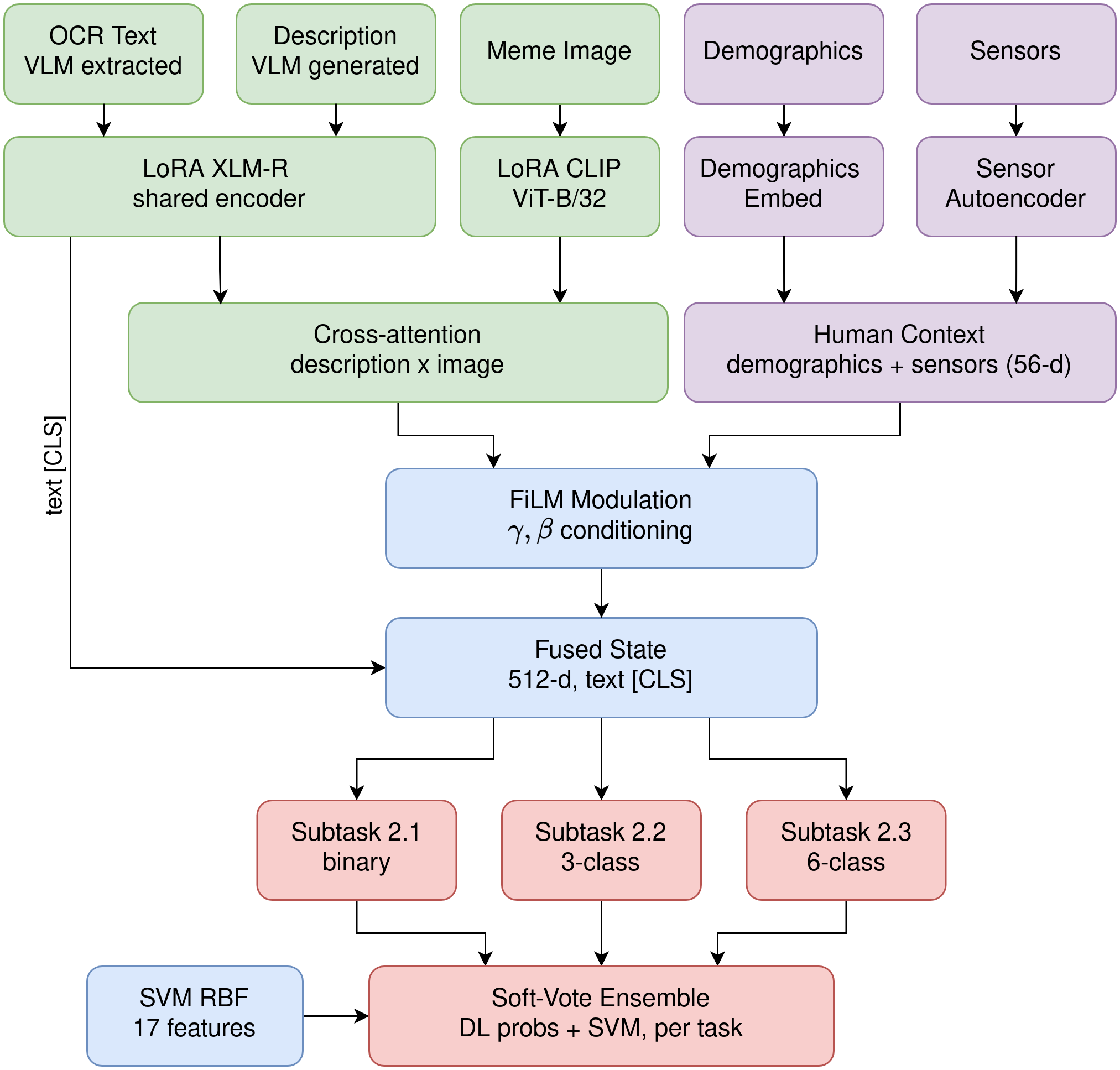
The system is a five-stage pipeline. Each meme is enriched with clean text and a structured visual description, expanded through cross-lingual translation, and fed to a deep multimodal network whose physiological branch is warm-started by a pretrained autoencoder and whose embedding space is shaped by an auxiliary contrastive objective. At inference, the network is soft-voted with a feature-based SVM.
VLM Enrichment
Gemma 4 (4-bit e4b, via Ollama) extracts clean, uncensored embedded text and a structured visual description from each meme at temperature 0.0. A fallback re-extraction pass with slightly relaxed sampling handles items whose JSON output fails to parse.
Cross-Lingual Augmentation
NLLB-200 translates cleaned text and descriptions between English and Spanish, roughly doubling the training set. Splits are assigned by parent ID so each augmented copy stays in the same split as its source, preventing leakage.
Sensor Warm Start
A symmetric sensor autoencoder (4 → 64 → 32) is pretrained to reconstruct the standardized 4-D physiological vector. Its encoder is transferred into the main model so fusion begins with a meaningful 32-D embedding rather than learning one from scratch.
Multimodal Fusion
A LoRA-adapted XLM-RoBERTa (shared for text and description) and a LoRA-adapted CLIP ViT-B/32 (image) feed a multi-head cross-attention layer that grounds the description in the image. The fused state is modulated by FiLM using the 56-D human-context vector and shared across three task heads.
Neural-Classical Ensemble
At inference the deep model is soft-voted with a feature-based SVM (RBF kernel, 17 handcrafted stylometric, demographic, and physiological features). The blend weight and threshold are grid-searched on validation to maximize macro F1.
Human Conditioning via FiLM
Demographic embeddings are averaged across a meme's annotators and concatenated with the 32-D physiological embedding to form a 56-D human-context vector. Two linear layers map it to per-feature scale and shift parameters that modulate the fused representation as h ⊙ (1+γ) + β. Both projections are zero-initialized, so the model begins as an unconditioned classifier and progressively learns how much to let annotator context reshape its predictions.
Data Analysis
The EXIST 2026 dataset comprises 3,984 memes viewed by 16 subjects, recording eye movements, heart rate, and EEG for each annotator. The text is almost perfectly balanced between English (n = 2,005) and Spanish (n = 1,979), so the network cannot falsely tie one language to the presence of sexism. Boxplot analysis shows that sexist content triggers significantly higher reaction times, fixation counts, and heart-rate variability, which points to evidence that sexist memes generate greater cognitive friction.
Demographic & Physiological Significance
| Category | Variable | Test statistic | p-value |
|---|---|---|---|
| Demographics (χ²) | Gender | χ² = 79.51 | < 0.001 |
| Demographics (χ²) | Age | χ² = 187.77 | < 0.001 |
| Demographics (χ²) | Study level | χ² = 45.77 | < 0.001 |
| Demographics (χ²) | Ethnicity | χ² = 41.13 | < 0.001 |
| Physiological (t-test) | Reaction time | t = 8.17 | < 0.001 |
| Physiological (t-test) | Fixations count | t = 5.52 | < 0.001 |
| Physiological (t-test) | Saccades count | t = 5.44 | < 0.001 |
| Physiological (t-test) | HR std. | t = 3.45 | < 0.001 |
| Physiological (t-test) | Mean pupil diameter | t = 0.00 | 0.9962 |
| Physiological (t-test) | Mean heart rate | t = −1.16 | 0.2466 |
| Physiological (t-test) | EEG alpha power | t = −1.01 | 0.3123 |
Table 1. Highlighted rows are the four physiological features retained for the neural branch (significant at α = 0.05). EEG bandpower was not individually significant and is exploited only by the classical SVM component. Eye-tracking metrics show extreme multicollinearity (Fixations and Saccades with ρ ≈ 1.0), so the 4-D sensor vector likely carries less independent information than its dimension suggests.
Text & Image Statistics
| Feature | Mean | Std. dev. | Median | Max |
|---|---|---|---|---|
| Character count | 124.30 | 104.72 | 96.00 | 1777.00 |
| Word count | 21.60 | 18.12 | 17.00 | 299.00 |
| Image width (px) | 713.41 | 355.18 | 640.00 | 4744.00 |
| Image height (px) | 745.33 | 405.74 | 650.00 | 6000.00 |
| Aspect ratio (W/H) | 1.03 | 0.34 | 1.00 | 3.22 |
| Pixel brightness | 138.31 | 43.55 | 136.03 | 251.79 |
Table 2. Descriptive statistics over N = 3,984 records. Text is short and right-skewed (75% of memes hold 26 words or fewer). The aspect-ratio distribution peaks at a 1:1 square, characteristic of meme formats, with brightness centered in the mid-tones.
Results
Official EXIST 2026 results for the best submitted run per language split. The system is most competitive on Subtask 2.2 (source intention) and clears the organizer majority-class baseline by a wide margin on Subtasks 2.1 and 2.2 (e.g. 0.4861 vs. 0.2947 hard ICM-Norm on 2.1, and 0.3612 vs. 0.1369 on 2.2). Subtask 2.3 is the hard case: the soft score (0.1568) beats the majority baseline of 0, but the hard score collapses onto it.
| Subtask | Split | Rank (soft) | ICM-Soft Norm | Rank (hard) | ICM-Hard Norm | F1 (hard) |
|---|---|---|---|---|---|---|
| 2.1 Binary sexism | All | 75/141 | 0.4109 | 117/214 | 0.4861 | 0.6920 |
| EN | 75/141 | 0.4292 | 86/214 | 0.5496 | 0.7336 | |
| ES | 70/141 | 0.3909 | 141/214 | 0.4306 | 0.6697 | |
| 2.2 Source intention | All | 29/114 | 0.3389 | 71/183 | 0.3612 | 0.3719 |
| EN | 30/114 | 0.3572 | 60/183 | 0.3854 | 0.3825 | |
| ES | 31/114 | 0.3169 | 69/183 | 0.3479 | 0.3644 | |
| 2.3 Fine-grained | All | 41/115 | 0.1568 | 138/184 | 0.0703 | 0.0919 |
| EN | 41/114 | 0.1607 | 143/183 | 0.0747 | 0.0938 | |
| ES | 38/114 | 0.1525 | 130/183 | 0.0667 | 0.0901 |
Table 3. Official EXIST 2026 results, best submitted run per split.
Our Findings
The pure deep model is the strongest single config
Trained on the non-augmented corpus with no SVM ensemble, it achieves the best validation (0.5210 ICM-Norm) and the best All-split test score (0.4861), beating every variant that adds augmentation or the ensemble.
Augmentation is a transfer mechanism, not a free win
Cross-lingual augmentation lifts the weaker language (Spanish) at the cost of the stronger one (English): on validation 0.4249 → 0.4925 ES while 0.5494 → 0.5001 EN. Our best English test score comes from the augmented + ensemble run.
The SVM ensemble is a regularizer
It helps in the noisier (augmented) training regime but adds variance when the deep model is already well fit. This is why no single submission dominates all splits.
No component survives multiple-comparison control
Across 63 ablation tests over 5 seeds, no architectural component (including FiLM annotator conditioning) produces an effect distinguishable from seed-to-seed variance after Holm-Bonferroni correction. The signal arises from integration, and we report this negative result openly.
The image stream stabilizes training
Removing it leaves the mean roughly unchanged but inflates variance dramatically (±0.089 on Subtask 2.1 vs. ≤ 0.023 for other ablations).
Subtask 2.3 is bound by multi-task interference
The 2.3 head collapses to a near-trivial solution across nearly all multi-task configurations; only single-task training on 2.3 breaks the pattern, pointing to interference rather than architecture as the binding constraint.
Ablation Studies
Augmentation & Ensemble
Four configurations on Subtask 2.1 isolate the contributions of cross-lingual augmentation and the SVM ensemble. The pure deep model on the non-augmented corpus gives the best All-split scores on both validation and test.
| Set | Aug. | Ens. | ICM-Norm All | ICM-Norm EN | ICM-Norm ES |
|---|---|---|---|---|---|
| Validation | – | – | 0.5210 | 0.5609 | 0.4679 |
| Validation | ✓ | ✓ | 0.4963 | 0.5001 | 0.4925 |
| Validation | – | ✓ | 0.4963 | 0.5494 | 0.4249 |
| Validation | ✓ | – | 0.4561 | 0.4540 | 0.4582 |
| Test | – | – | 0.4861 | 0.5414 | 0.4306 |
| Test | ✓ | ✓ | 0.4712 | 0.5496 | 0.3929 |
| Test | – | ✓ | 0.4657 | 0.5235 | 0.4079 |
Table 4. Subtask 2.1 hard evaluation. Aug. marks cross-lingual translation augmentation during training; Ens. marks the SVM soft-vote at inference. Augmentation lifts Spanish but degrades English; the ensemble helps in the noisier augmented regime but adds variance otherwise. The augmented-without-ensemble run was not submitted.
Architectural Components (5 seeds, Holm-Bonferroni)
Each component was disabled independently and retrained over five seeds. We applied paired Welch t-tests against the baseline across a family of 63 comparisons and corrected with the Holm-Bonferroni step-down procedure at α = 0.05. No ablation survives the correction; the closest case (removing the visual description on Subtask 2.3 soft, uncorrected p = 0.001) fails the Holm threshold (≈ 0.00079).
| Configuration | 2.1 ICM-Norm | 2.2 ICM-Norm | 2.3 ICM-Norm |
|---|---|---|---|
| Full system (baseline) | 0.4877 ± 0.0066 | 0.3517 ± 0.0158 | 0.1174 ± 0.0018 |
| w/o FiLM conditioning | 0.4773 ± 0.0209 | 0.3438 ± 0.0200 | 0.1174 ± 0.0018 |
| w/o visual description | 0.4863 ± 0.0223 | 0.3565 ± 0.0193 | 0.1206 ± 0.0031 |
| w/o image | 0.4863 ± 0.0890 | 0.3255 ± 0.0924 | 0.1174 ± 0.0018 |
| text only | 0.4957 ± 0.0210 | 0.3405 ± 0.0250 | 0.1174 ± 0.0018 |
| w/o SupCon loss | 0.4876 ± 0.0094 | 0.3539 ± 0.0143 | 0.1174 ± 0.0018 |
| w/o auxiliary head | 0.4827 ± 0.0093 | 0.3567 ± 0.0067 | 0.1174 ± 0.0018 |
| Single-task (2.1 only) | 0.3889 ± 0.0024 | – | – |
| Single-task (2.2 only) | – | 0.3406 ± 0.0099 | – |
| Single-task (2.3 only) | – | – | 0.1346 ± 0.0246 |
Table 5. Validation hard-evaluation ICM-Norm, mean ± std. over five seeds, non-augmented deep model only. The no-image variant shows dramatically higher variance, suggesting the image stream provides training stability even when its mean contribution is small. The 2.3 head collapses to a near-identical value across multi-task configurations and is broken only by single-task training on 2.3.
Configuration
| Knob | Value |
|---|---|
| Text encoder | FacebookAI/xlm-roberta-base (LoRA) |
| Image encoder | openai/clip-vit-base-patch32 (LoRA) |
| LoRA rank / α / dropout | 16 / 32 / 0.1 |
| Projection / fused dims | 256-D fused, 512-D state, 128-D contrastive |
| Human-context vector | 56-D (demographics + 32-D sensor embedding) |
| Sensor autoencoder | 4 → 64 → 32, MSE, 50 epochs |
| Differential LR (heads / LoRA) | 3e-5 / 8e-6, weight decay 0.1 |
| Batch / grad-accum / clip | 16 / 4 / 1.0 |
| Loss weights (aux / contrastive) | 0.3 / 0.1, SupCon τ = 0.07 |
| Epochs / seed / train ratio | 50 / 42 / 0.8 |
| Ensemble SVM | RBF, C = 1.0, balanced; OvR for 2.3; 17-D features |
Hardware
- Multimodal training (LoRA): NVIDIA RTX 3060 and RTX 4090
- Multi-seed ablations: up to 4 GPUs in parallel, one seed per device
- VLM enrichment: local Ollama server with Gemma 4 (e4b)
Limitations
Meme-level aggregation
Physiological and demographic signals are averaged across a meme's annotators, discarding individual-level variation. A viewer-specific model could better capture the subjectivity the dataset was designed to expose.
Redundant sensor features
Eye-tracking metrics are extremely collinear (Fixations and Saccades, ρ ≈ 1.0), so the 4-D sensor vector likely carries less independent information than its dimensionality suggests.
Underused EEG
EEG was not individually significant and enters only through the SVM. Richer temporal EEG modeling, rather than aggregated bandpower, might unlock signal the current setup leaves unused.
Class coverage on 2.3
Severe class imbalance and a soft objective that does not penalize ignoring rare classes leave per-class F1 at 0.0 for minority categories, keeping Subtask 2.3 near the trivial baseline.
Augmentation trade-off
Cross-lingual augmentation lifts Spanish but degrades English. Translation-quality filtering or back-translation consistency checks might preserve the benefit without the cost.
Separate optimization
The deep model and the SVM are optimized separately and combined by grid search rather than trained jointly end-to-end; tall storytelling memes are square-padded rather than split into sub-images.
Contact & Acknowledgements
For questions and collaboration inquiries, please reach the authors through the GitHub repository or academic channels.
The research presented in this paper is supported in part by The Academy of Romanian Scientists, through the funding of the project “NetGuardAI: Intelligent system for harmful content detection and immunization on social networks” (AOȘR-TEAMS-IV).
Citation (Placeholder until the official proceedings entry is available)
@InProceedings{Mocanu_2026_EXIST_CLEF,
    author    = {Mocanu, Ana-Maria Luisa and Mocanu, Sebastian and Truică, Ciprian-Octavian and Apostol, Elena-Simona},
    title     = {Through the Eyes of the Beholder: Biometric and Demographic Conditioning for Multimodal Sexism Detection},
    booktitle = {Conference and Labs of the Evaluation Forum (CLEF), EXIST 2026 Lab, Task 2},
    month     = {September},
    year      = {2026}
}